
Does Your Agency Sell You with Seniors but Deliver with Juniors?
Agencies sell with senior staff and deliver with junior staff because senior time is limited and the sales stage is where it counts most. This is a structural pattern, not necessarily bad faith. Clients can spot the handover through specific checkpoints during the first few months, and they can reduce the risk by agreeing on team and contract terms before they sign.
Why the Handover Is Built into Agency Economics
Senior strategists are expensive and finite. A senior person has a limited number of hours each week, and those hours are spread across every client, sales target and crisis in the agency. When an agency wins a new account, it has a strong reason to put its most experienced people in front of the prospect, because those people are what persuade a buyer to sign. Once the contract is live, the same people have to support many other accounts, so the day-to-day work usually moves to staff with less experience.
Beware the Bait-and-Switch: Senior Strategist vs Junior Execution | Stefano Mazzei posted on the topic | LinkedIn makes this capacity argument directly. Its author argues that senior attention does not scale, so agencies front-load senior involvement during the sale and then transition the account to junior execution. The week-by-week sequence in that post is an illustration rather than measured data, but the mechanism it describes is easy to follow.
Agency growth adds pressure. Consider a hypothetical agency with four senior strategists and twenty clients. If it wants to take on ten more clients without raising prices, the cheapest way to add capacity is to hire junior account managers and assign them to the new work. Senior strategists cannot be hired as quickly, and each one can only oversee so many accounts. Over time, the average person handling a client's campaigns becomes less experienced, even though the agency's brand and sales team still look senior.
Agencies also face competing priorities. They need to keep existing clients satisfied, win new work, control margins and retain staff. None of these goals is inherently dishonest, but together they make it hard to keep senior involvement at the level that was sold. Understanding this helps a client approach the problem as a business constraint to be managed, rather than as proof that the agency set out to mislead them.
Where Quality Slips After Juniors Take Over
When junior staff take over, quality depends on how well the agency trains and supports them. Christiana Sara, writing in What’s Stopping Your Digital Marketing Agency From Scaling And How To Easily Fix This – JobPrepped, argues that junior marketers often need structured training and weekly support before they deliver consistently. That article comes from a training provider promoting its own programme, so its framing reflects that provider's view. Its underlying point is still useful: without structure, juniors make avoidable mistakes.
The same article describes a cycle that clients will recognise. When junior work underperforms, senior staff are pulled in to fix it. Each hour spent on rework is an hour not spent on the strategic oversight the client was sold. For example, if a senior strategist is reviewing a junior's bid adjustments every week, that strategist has less time to review the overall account strategy or prepare for a quarterly planning session.
Weak support can also affect staffing stability. The article links junior turnover to insufficient support and notes that when junior staff leave, the agency loses account knowledge and must retrain their replacements. For a client, this can mean that the person who understood the account's history, past tests and customer feedback is gone, and the new person has to learn it again. Campaigns can drift during that gap.
The combined effect is lower quality, slower progress and weaker margins for the agency, which can lead to more pressure on the client account. The client sees fewer senior insights, slower responses and less consistent reporting. None of this proves a specific agency is at fault, but it explains why the gap between the sales pitch and the day-to-day service can widen over time.
How to Spot the Handover Early
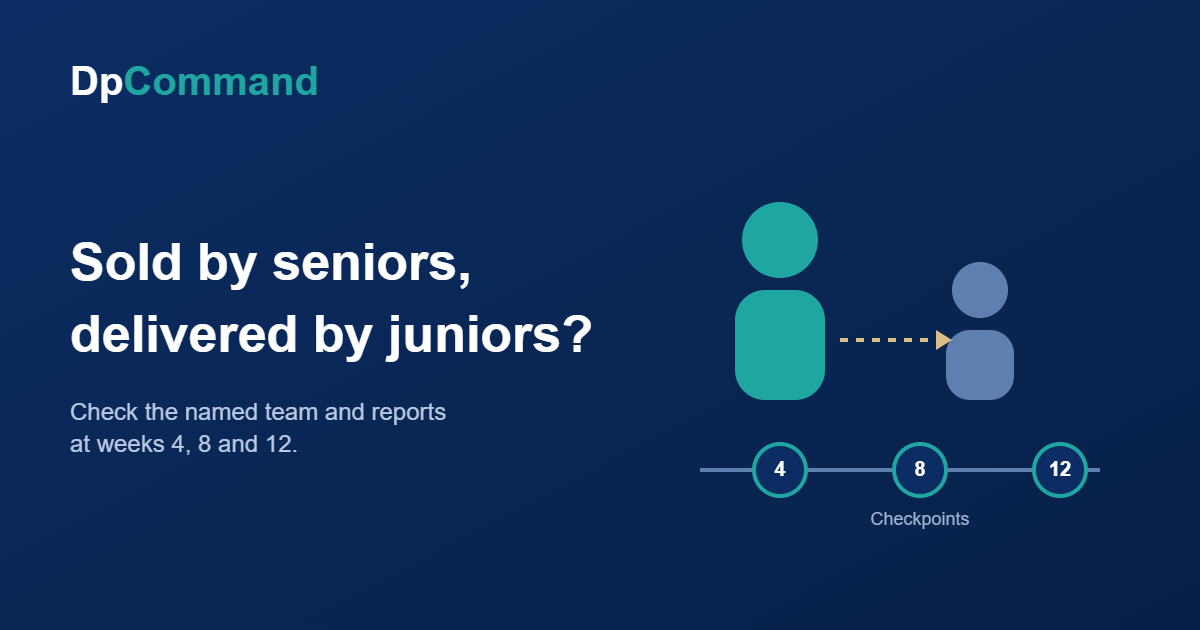
The clearest way to identify a handover is to compare who was involved at each stage. Make a simple record during the sale and onboarding, then check it at weeks four, eight and twelve. Note the name, role and time commitment of each person who attends calls, reviews strategy or sends reports.
Beware the Bait-and-Switch: Senior Strategist vs Junior Execution | Stefano Mazzei posted on the topic | LinkedIn gives a practical set of checkpoints. At week four, ask who is on the weekly call and, if it is not the person from the sales call, ask why. At week eight, ask who reviews creative strategy, and if the answer is a junior, ask for senior involvement. At week twelve, check whether the senior contact is still engaged. These checks are presented as practical questions rather than verified outcomes, but they give a client a fixed schedule for asking about the account.
Agency Bait-and-Switch: Senior Sells, Junior Delivers lists five warning signs. Its author describes these as practitioner observations from an ex-agency owner rather than measured findings, so treat them as signals to investigate rather than proof:
- Your senior contact has been replaced by someone you have not met, and the explanation focuses on the agency's account management structure.
- Replies take days, emails go unanswered, or calls are not returned.
- Reports contain metrics without interpretation and could apply to any client.
- Strategy questions are deferred, with promises to check with the team instead of clear answers.
- The agency's explanation of its structure avoids your market, customers and competitive position.
Templated reports deserve a careful distinction. A report that uses a standard layout may simply reflect an overloaded team, and a standard template is not necessarily a sign of poor work. The more important question is whether the report interprets your own results and market. A useful report explains why performance changed, what the agency tested, what it plans to change next and what the client should decide. A report that only lists numbers, with no reference to your specific situation, is a stronger warning sign, regardless of how polished it looks.
When you see several signs at once, raise them in writing. Keep dates, names and examples. A clear record is more useful than a general complaint, and it gives the agency a specific issue to address.
Prevent It Before Signing, and Respond After
The most effective protection comes before you sign. Ask who will work on your account week to week, and get the answer in writing. Agency Bait-and-Switch: Senior Sells, Junior Delivers recommends asking two experience questions about each named person: how many years they have worked in this exact speciality, and how many clients like yours they have personally managed. Vague answers about "team experience" do not answer either question. You should also ask for each person's current client load so you know how much of their time is available for your account.
Next, discuss contract terms with the agency and a qualified adviser. The following points are items to raise, not legal advice:
- Named senior involvement, specifying which strategist will attend, what they will do and how often. For example, a monthly strategy review and a quarterly deep dive.
- Notice and approval of team changes. At minimum, you should be told when your account team changes, and ideally you should be able to approve a replacement.
- A penalty-free exit if the named senior staff leave, so you are not locked into a contract that no longer reflects what you bought.
If the gap already exists, respond with specific, dated written requests rather than general complaints. Agency Bait-and-Switch: Senior Sells, Junior Delivers suggests this approach because agencies rarely refuse a reasonable request that is clearly stated. Examples include naming a senior reviewer for your account, keeping a monthly change log that shows what was altered and by whom, or capping how many other accounts your manager carries. A written request creates a record, and the agency's response will tell you how seriously it takes the issue.
Options When the Gap Is Confirmed
If the handover has already happened, you have several options. They are not mutually exclusive, and the right choice depends on how much the gap affects your results and how much disruption you can absorb.
Request Specific Changes
Start here. Ask for a meeting with the person who sold you the account, and ask them to explain the difference between what was promised and what is being delivered. Bring specifics, including unanswered questions, response times and examples of templated reports. Then request one or two concrete changes, such as a named senior reviewer or a monthly change log, and set a date to check whether they have been delivered.
Escalate
If specific requests are ignored or answered vaguely, escalate to a more senior person at the agency, such as a managing director or founder, and restate your requests in writing. Keep your record of dates, responses and missed commitments. Escalation is most effective when your requests are reasonable and your evidence is clear.
Change Agencies While Preserving Campaign History
Switching agencies takes preparation. Before you leave, request full access to your ad accounts, analytics, reports, creative assets, tracking setup and change logs. Confirm that you own these assets and that the new agency can work from them. Plan the handover so that campaigns are not left unmanaged during the transition. Switching can reset some of your data history, so document what you have before you move.
Retain More Control over Content Production
Some owners choose to bring more of their content work in-house, where they can set approval rules and track changes themselves. This still depends on having qualified content producers and reviewers, so the approach works best when you can name the people who will check the output and approve it.
For owners of websites with service and location pages, How DpCommand Works is one option to evaluate. DpCommand uses structured templates and fields to hold page content, runs preflight checks before publication, stores content as versioned assets and requires a human approval step before anything is published. These controls help your team manage content production directly. They do not replace agency staffing decisions or the need for qualified reviewers, and they do not address the wider question of who manages your paid media or strategy.
What to Do Next
The practical takeaway is simple. Ask who will work on your account week to week, get the answer in writing, and check the account at weeks four, eight and twelve. Compare the people you see with the people you were sold, and read reports for interpretation rather than just numbers. If the gap is real, make specific, dated written requests before deciding whether to stay, escalate or leave. Agencies are not always acting in bad faith, but clients who ask clear questions at the right time are far less likely to be surprised by who actually does the work.