
Five small marketing agency challenges every owner knows by heart, and what changes when the work runs on DpCommand.
It’s 10:40 on a Tuesday night. The house is quiet. You’re not working on strategy for the client you just signed, which is the reason you started this business. You’re in WordPress, fixing a city page that went live with last quarter’s phone number, because you’re the only one who remembers the client changed it. Again.
Tomorrow there will be another one. A template someone tweaked by hand. A batch of location pages that looks nothing like the last batch. A client asking, nicely, for “just one more page.”
If you run a small agency, you already know the hardest small marketing agency challenges have nothing to do with time management. You’re good at this. Your clients like you. The trouble is that the business runs on you: your memory, your evenings, your judgment applied one page at a time.
We built DpCommand for agencies like yours, for the owner having that Tuesday night. Below are the five small marketing agency challenges we hear about most often, what they actually cost you, and what DpCommand does about each one. Where DpCommand doesn’t solve something, we’ll say that too.
1. “Ask Sarah. She knows how we do it.”
A new hire asks how you build location pages. The honest answer is: it depends who’s doing it. Sarah has her way. You have yours. The contractor you used in the spring had a third. There’s a Google Doc called “SOP – FINAL v3” that nobody has opened since March.
So every account looks a little different depending on who touched it last. Onboarding someone new means weeks of shadowing and hoping the right habits stick. When Sarah takes a vacation, things quietly break.
Undocumented process isn’t laziness. It’s what happens when a team is too busy delivering to write down how it delivers. But it means your quality lives in people’s heads, and heads walk out the door.
What DpCommand changes: your way of doing it becomes the system.
In DpCommand, the standard isn’t a document someone has to remember to read. It’s how the work gets done.
- Templates and template versions set the structure of each kind of page. Fields hold the parts that change from page to page, such as the service, the city and the local details.
- AI prompts and system instructions are managed centrally and versioned, not left to whoever happens to be typing into a chat window that day.
- AI drafts inside that structure, and people approve the result. Generated content is stored as reviewed, versioned assets, and nothing is applied to a page until your team has approved it.
- Pages move forward one step at a time. Each step has its own checks, and a page moves forward only when the step before it is complete. Missing content and unfinished fields get caught before anything ships.
A new operator doesn’t need to absorb your habits by osmosis. They learn the platform, and the platform already carries your standards. See the full operating sequence on how DpCommand works.
2. Everything runs through you
You’re the lead strategist, the account manager, the salesperson and the final reviewer on every deliverable, because you’re the only one who knows what “good” looks like.
You can feel the ceiling. The weeks you’re pitching new business, delivery slows down. The week you’re sick, it stops. You took your phone to the pool on your last vacation, and you know exactly why.
You’re not alone in this. In AgencyAnalytics’ 2026 survey of nearly 500 agency professionals, “time pressures and stress” was the second most common top challenge, behind only winning new clients (AgencyAnalytics). In a 2025 survey of UK agency staff, 95% said they work overtime and 88% said they work weekends (Resource Guru).
What DpCommand changes: you decide once, and then you approve.
DpCommand doesn’t replace your judgment. It stops making you spend it on the same decision over and over.
- What “good” looks like for a service page is set once in a template and its prompts. After that, your team works inside it.
- Instead of rebuilding a page, you review a preview of the finished page and approve it.
- The knowledge stays when people leave. Client structure, templates, keywords, content and publishing state live in the platform, not in one person’s spreadsheets and memory.
You stay the expert. You just stop being the bottleneck.
3. “Just one more quick thing”
“Could you add a page for Belleville too? Shouldn’t take long.”
You say yes. You always say yes, because saying no feels like risking the relationship you worked so hard to build. Then it’s a revised headline, then a second city, then “while you’re in there.” None of it is billed. All of it pushes back work for clients who are paying.
This is about as common as project problems get. PMI’s 2018 Pulse of the Profession found that 52% of projects completed in the previous year experienced scope creep (PMI). Teamwork.com puts it bluntly: when extra requests can’t be tied to extra budget, “every ‘small favour’ is a silent write-down” (Teamwork.com).
What DpCommand changes: you sell scope you can see and count.
DpCommand won’t write your contract or chase change orders for you. What it changes is what you’re selling.
- Programs can be packaged around units you can count, such as managed market targets (a page type in a geography for a search target), locations, and posts per month, instead of a vague bucket of hours. “Add Belleville” stops being a favor. It’s a new market target with a price you set. Here’s how agencies package DpCommand programs.
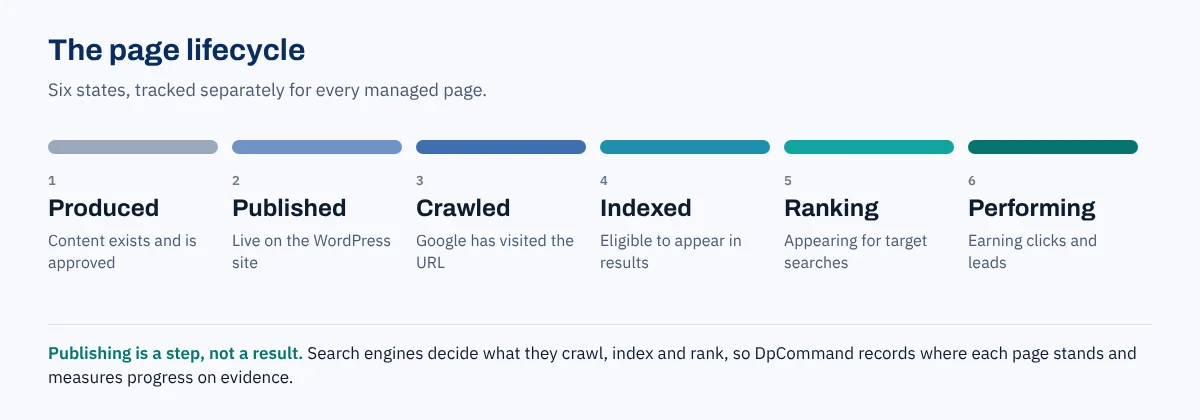
- Every page carries its own status: produced, published, and what Google has crawled and indexed. When a client asks what they’re paying for, you can show them. Learn more about the page lifecycle.
- When a request touches many pages, you make the change once. Change the template or a shared component, and roll it through every page that uses it.
A clear boundary is easier to hold when both of you can see it.
4. Drowning one month, waiting the next
Three new clients sign in the same week. You celebrate for about an hour. Then you do the math on who’s going to write 300 location pages.
Two months later, a client cancels and you’re paying a writer to wait.
The benchmark says delivery roles should run at roughly 70–90% of their week to stay profitable (Parakeeto). Most small agencies have no reliable way to know where they are. The UK survey found 38% of agency staff still plan resources in Google Sheets (Resource Guru). And the margin for error is thin. In a survey of 294 U.S. agencies, the median small-agency client spent $749 a month (Vendasta). At that price, there’s no room for 40 hours of hand-built pages.
What DpCommand changes: page production stops growing at the same rate as your headcount.
DpCommand isn’t a timesheet or resource-planning tool. It goes after the reason capacity swings so hard in the first place: in a manual agency, every new page needs more human hours.
- Your team’s hours go into strategy, setup and review. Turning approved content into finished pages and publishing them in bulk is work the system runs.
- Large footprints become something you can deliver. Multi-city, multi-state and franchise programs that would bury a small team by hand become realistic to propose. See what DpCommand means for multi-location businesses.
- Capacity is something you can count. DpCommand plans scale with managed targets, operator seats and processing capacity, so growth is a plan decision, not a hiring scramble.
The goal is more search coverage per person on your team, without labor growing at the same rate.
5. Twelve tabs, and none of them agree
The spreadsheet says the page exists. WordPress says it’s a draft. Search Console says “Crawled – currently not indexed.” The approved copy is in a chat window somewhere, and the client’s sign-off is buried in Slack.
Every handoff between tools is a place for work to get lost and a reason for your team to stop and figure out where they were. Researchers writing in Harvard Business Review found that workers toggled between apps and websites nearly 1,200 times a day and spent just under four hours a week reorienting themselves after switching (HBR).
What DpCommand changes: one record of what should exist, and proof of what does.
- Each managed page keeps one operating record: its template, its content, its approvals, its WordPress page and its publishing state.
- Publishing to WordPress happens in batches you select and can watch, with reconciliation between what DpCommand says should exist and what WordPress actually holds.
- Google Search Console inspection and indexing-issue review sit next to the pages themselves, so when Google flags a problem, the fix is in the same place.
- When something fails, work picks back up. AI providers have rate limits and outages, and DpCommand is built to resume a run rather than start it over.
DpCommand doesn’t replace every tool you use. WordPress still serves your client’s site, Search Console still reports on Google, and your analytics, rank-tracking and CRM tools still do their jobs. DpCommand connects the work that used to fall between them. Check the requirements to see what a client site needs.
What we won’t tell you
You’ve heard enough promises from software vendors, so here is where we draw the line.
- We won’t promise rankings, traffic or revenue. Google decides what it indexes and ranks. DpCommand helps you do the work well and see where every page stands.
- We won’t tell you AI replaces your team. AI does the drafting. Your people stay responsible for strategy, standards, review and approval.
- We won’t compete with you for your clients. DpCommand powers your agency. Your clients stay yours, along with your pricing, your strategy and your margin.
- We’ll tell you what’s current and what’s coming. Some capabilities you might want, such as rank tracking and competitor intelligence, are on our roadmap, not in the product today. We label them that way on how it works.
DpCommand is built for SEO and digital agencies with recurring WordPress clients, especially agencies serving multi-location, franchise or growing businesses. If your work is mostly paid media, social or one-off creative, we’re probably not the right fit, and we’d rather tell you that now.
The Tuesday night doesn’t have to be the job
You started this agency because you’re good at helping businesses get found. Somewhere along the way the job became remembering phone numbers, rebuilding templates and saying yes to one more favor. None of these small marketing agency challenges mean you’re doing it wrong. They mean the work has outgrown the way it’s being done.
DpCommand gives that work a system, so you can get back to the work only you can do.
See what your delivery capacity could look like. Book a demo.
| Struggle | What it costs you | What DpCommand changes |
|---|---|---|
| Undocumented process | Inconsistent work and slow onboarding | Templates, managed prompts and approvals carry your standards |
| Everything runs through you | Delivery stalls when you do | You decide once, then review and approve |
| Scope creep | Unbilled work and eroding margin | Scope packaged in units you can count |
| Capacity swings | Overloaded one month, idle the next | Page production no longer grows with headcount |
| Tool sprawl | Lost work and constant reorienting | One record per page, with proof of its state |
The five small marketing agency challenges at a glance.
Small marketing agency challenges: frequently asked questions
What are the biggest small marketing agency challenges?
The five that come up most are undocumented processes, founders who become the bottleneck, scope creep, capacity that swings between overloaded and idle, and work scattered across too many tools. Winning new clients is also hard: it was the top challenge for 30% of agency leaders in AgencyAnalytics’ 2026 survey (AgencyAnalytics).
How can a small marketing agency stop scope creep?
Define what the client is buying in units both sides can count, such as pages, markets, locations or posts per month, and tie every new request to one of those units or to added budget. Scope creep thrives when the deliverable is vague. Agencies using DpCommand can package programs around managed scope and show the client exactly what is in it.
Why do agency founders become the bottleneck?
Usually because the agency’s standards live in the founder’s head, so every deliverable needs the founder’s review or rework. The fix is to put those standards into the way work is produced, through shared templates, managed instructions and a clear approval step, so the founder approves work instead of redoing it.
What utilization rate should agency delivery staff target?
Agency-finance consultancy Parakeeto puts weekly delivery targets for most production roles at roughly 70–90% (Parakeeto). The right number depends on your pricing, costs and role design, so treat any benchmark as a starting point rather than a rule.
Does DpCommand replace my SEO and analytics tools?
No. WordPress still serves the client’s site, Google Search Console still reports on Google, and your analytics, rank-tracking and CRM tools keep doing their jobs. DpCommand manages content and page operations on client-owned WordPress sites and connects the work between those tools. See the requirements for what a site needs.
Can DpCommand guarantee rankings or traffic?
No, and no platform honestly can. Google decides what it crawls, indexes and ranks. DpCommand records where each page stands, from produced and published to crawled and indexed, so progress is measured on evidence. Read more about the page lifecycle.
Is DpCommand right for my agency?
It fits best for SEO and digital agencies with recurring WordPress clients and significant content delivery, especially those serving multi-location or franchise businesses. It is a limited fit for agencies focused mainly on paid media, social or one-off creative work. Our FAQs cover more, or you can book a demo.
Sources
- AgencyAnalytics, 2026 Marketing Agency Benchmarks Report (494 respondents, surveyed February–April 2026)
- Resource Guru, 2025 agency report: The cost of overworking for client-facing teams (OnePoll survey of 373 UK agency workers, February 2025)
- PMI, “Scope Patrol,” PM Network, July 2018, citing Pulse of the Profession 2018
- Teamwork.com, Margin erosion in professional services
- Parakeeto, Resource utilization and capacity planning for marketing agencies
- Vendasta, Small vs. large agency trends (survey of 294 U.S. digital agencies with Dialog)
- Murty, Dadlani and Das, “How Much Time and Energy Do We Waste Toggling Between Applications?” Harvard Business Review, August 29, 2022